

- More than 8,000 visitors of all ages from Romania, Germany, the United Kingdom, the Netherlands, Austria, Israel, the United States, Norway, Hong Kong, Spain and other European countries attended the 2024 edition of Haferland Week.
- Nearly 60 cultural events, including concerts, conferences, guided tours, workshops and exhibitions, were organised throughout this year’s edition.
- For the second consecutive year, the event was held under the High Patronage of a member of the Princely House of Liechtenstein—Prince Philipp von und zu Liechtenstein.
- For the first time in its history, the festival took place under the auspices of the Romanian Royal Family.
- The festival also marked the 700th anniversary of the first documentary mention of Rupea Fortress, an event attended by approximately 2,000 participants.
- During the festival, the annual meeting of the Romanian-German Bilateral Cooperation Forum took place.
- For the first time, the festival hosted an adventure and non-formal education camp for children and teenagers, organised in partnership with The Duke of Edinburgh’s International Award, a global organisation founded in the United Kingdom.
Bucharest, 12 August 2024. The 12th edition of Haferland Week, the most beloved cultural and ethnographic festival of the Transylvanian Saxons, recorded more than 8,000 visitors from Romania, Germany, the United Kingdom, the Netherlands, Austria, Israel, the United States, Norway, Hong Kong, Spain and other European countries.
Nearly 60 cultural events were organised over four days (8–11 August) across ten localities in Haferland: Archita, Saschiz, Homorod, Rupea, Criț, Roadeș, Meșendorf, Cloașterf, Bunești and Viscri.
The 2024 edition of Haferland Week was held under the High Patronage of His Serene Highness Prince Philipp von und zu Liechtenstein and, for the first time, under the auspices of the Romanian Royal Family.
Among the events that attracted the largest number of visitors were organ concerts, performances of baroque music, opera and jazz, as well as the traditional Saxon Ball—an annual highlight of the festival—featuring a live performance by the German band HighLife.
Also highly appreciated were the performances of traditional Saxon brass bands, 16th-century German music and 18th-century Swabian songs, along with guided tours, presentations of traditional Saxon wedding customs, and visits to Saxon households and farmsteads.
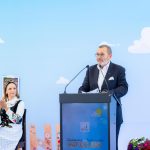
At this year’s edition, alongside the organisers—Mr Michael Schmidt, President of the M&V Schmidt Foundation, and Ms Veronica Schmidt, Vice President of the Foundation—the festival was attended by distinguished guests including His Serene Highness Prince Philipp von und zu Liechtenstein, Prince and Princess Alexander von und zu Liechtenstein, H.E. Dr Peer Gebauer, Ambassador of Germany to Romania, H.E. Emil Hurezeanu, Ambassador of Romania to Austria, H.E. Willemijn Van Haaften, Ambassador of the Netherlands to Romania, H.E. Adriana Stănescu, Ambassador of Romania to Germany, Mr Adrian Ioan Veștea, Minister of Development, Mr Andrew Noble, former British Ambassador to Bucharest and member of the Board of Directors of the M&V Schmidt Foundation, Mr Șerban Todorică, President of the Brașov County Council, and Mr Alexandru Opriș, Mayor of Rupea.
Also present were Dr Bernd Fabritius, President of the Federation of Expellees, Mr Rainer Lehni, President of the Association of Transylvanian Saxons in Germany, Mr Martin Bottesch, President of the Democratic Forum of Germans in Transylvania, and Mr Gunther Krichbaum, Member of the German Bundestag.
Haferland, a Preferred Destination for Cultural, Gastronomic, Adventure and Agrotourism
From year to year, Haferland Week continues to grow, reflecting both the vitality of the Transylvanian Saxon community and the ongoing development of the region, which is gradually becoming one of the preferred holiday destinations for tourists from Romania, Europe and the United States.
“The growing interest in our festival is evident, both in the number of visitors and in the distinguished guests who honoured us with their presence this year, as well as in the extraordinary dynamism of this region,” said Mr Michael Schmidt. “Today, the villages of Haferland offer cultural tourism, with visits to fortified churches and Saxon homesteads; gastronomic tourism; adventure tourism along the Via Transilvanica and the trails between villages; hiking, mountain sports, organic farming and much, much more.”
All of this would not have been possible without the involvement of local communities and the support of our friends from near and far. We therefore extend our deepest gratitude to His Serene Highness Prince Philipp, Prince and Princess Alexander von und zu Liechtenstein, the Romanian Royal Family, our sponsors and partners, the festival team, and above all to everyone who, working with dedication behind the scenes, has helped place Haferland back on the map of Romania’s most cherished destinations.
Following Rupea Fortress, the Fortified Church in Homorod Will Also Be Restored
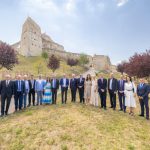
The main highlight of this year’s edition was the anniversary ceremony marking 700 years since the first documentary mention of Rupea Fortress, the largest historic monument of the Saxons in Haferland. Its restoration was completed more than a decade ago, after the complex had been abandoned for over 200 years.
In the coming period, restoration and adaptive reuse works will also be carried out on the fortified church in Homorod, one of the oldest places of worship in the region, dating back to 1270. According to experts, this church houses the oldest mural painting on the territory of Romania.
Haferland for Young People: Adventure and Non-Formal Education in Saxon Villages with The Duke of Edinburgh’s International Award Romania
This is the first year in which the festival hosted, in partnership with The Duke of Edinburgh’s International Award Romania, an educational and adventure camp for 21 young participants. Together with a team of adult supervisors, the young people completed the Adventurous Journey section of the Award programme over four days in the heart of Haferland.
Participants took part in a wide range of activities, including camping, team-building sessions, television journalism training, hiking along the Via Transilvanica, creating a video travel journal, traditional culinary experiences, treasure hunts, workshops with children, participation in the Saxon Ball, and campfires, among others.
Delivered globally, The Duke of Edinburgh’s International Award provides international recognition and a structured framework of non-formal education activities for young people aged 14 to 24. At international level, the programme is patronised by His Royal Highness The Duke of Edinburgh, while at national level it is patronised by Her Majesty Margareta, Custodian of the Romanian Crown.
“This edition of the festival has demonstrated the power of culture to bring people together and to revitalise an entire community,” said Veronica Schmidt, Co-Founder and Vice President of the M&V Schmidt Foundation.
“I am delighted that once again this year Haferland Week was held under the High Patronage of a member of the Princely House of Liechtenstein, His Serene Highness Prince Philipp, thanks to the diligent and generous efforts of Princess Astrid von und zu Liechtenstein, a friend of Romania with whom I share a long-standing and close relationship.
Beyond the success of this edition, I would like to highlight the joy brought to all of us by the new programme for children and young people that we are hosting in partnership with The Duke of Edinburgh’s International Award. For me personally, as a mother and as the initiator of a programme dedicated to children from disadvantaged backgrounds in Criț, this marks a new beginning. We are thus opening another chapter in the history of Haferland Week, one that speaks about education and the future of children. Only through education and personal effort can we develop Haferland. And this future is being built right here, in our community.”
Interethnic Cooperation and Dialogue, a Key Theme of the Romanian-German Bilateral Cooperation Forum Meeting
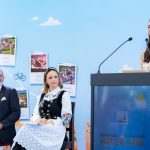
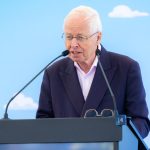
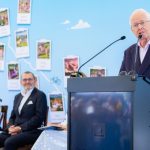
“You are an anchor here,” H.E. Dr Peer Gebauer, Ambassador of Germany to Bucharest, told representatives of the Saxons in Romania during the meeting of the Romanian-German Bilateral Cooperation Forum (FCBRG) held in Criț.
This year’s Forum meeting—a non-profit organisation founded as a platform for exchanges on cultural, social, economic and scientific topics between Romania and Germany—was attended by, among others, Prince Philipp, Prince and Princess Alexander von und zu Liechtenstein, H.E. Emil Hurezeanu, H.E. Adriana Stănescu, H.E. Willemijn Van Haaften, Dr Bernd Fabritius, Mr Michael Schmidt, Mr Martin Bottesch, Mr Andrew Noble, and Count Tibor Kálnoky, who, through his foundation, is also involved in the restoration of castles and houses belonging to the Szekler community.
“In 1990, a quarter of a million Saxons emigrated from Romania,” said H.E. Emil Hurezeanu. “Today, Saxons are returning to Transylvania, to Banat, to Baia Mare, to their places of origin.”
They are often young people born in Germany to emigrant parents who return here wearing their traditional costumes. It is imperative that we preserve this multicultural tradition.”
“In the current geopolitical context, Romania plays an extraordinary role as a trusted partner. Given Germany’s greatly increased interest in Romania, we are now operating at a different level of cooperation,” said H.E. Dr Peer Gebauer, in the context of discussions on European cooperation in the fields of security and the defence industry.
The theme of ethnic coexistence in Romania and Germany as a framework for dialogue, democracy and tolerance was repeatedly emphasised by participants, with reference not only to the Transylvanian Saxon community in Romania, but also to the Romanian diaspora in Germany—numbering nearly one million people and representing one of the largest Romanian communities abroad.
In this context, Dr Bernd Fabritius spoke about the recently concluded International Meeting of Saxons in Sibiu, where tens of thousands of people—Saxons, Hungarians and Romanians alike—celebrated together in the Great Square. “The Polish-German Forum, where I served as co-chair, could not achieve such a result, for example,” he said. “We must make use of this moment.”
H.E. Adriana Stănescu also referred to Saxon organisations in Germany, which often provide assistance to Romanian emigrants. Calls were likewise made to broaden the Forum to include other minority groups.
Rupea Fortress: Anniversary Celebrated with 2,000 Visitors
The esplanade in front of Rupea Fortress was filled to capacity during the ceremony marking 700 years since the first documentary mention of this major historic monument. The event featured a commemorative service at the Evangelical Church in Rupea, followed by festive speeches and a concert of traditional Saxon music on the fortress esplanade.
“There is a moment of discovery, as 800 years ago when Germans arrived in Transylvania, and a moment of separation, such as during the Saxon emigration; however, what must not happen is a moment of forgetting,” said H.E. Emil Hurezeanu in Rupea. “The solution is a moment of rediscovery—when Germans rediscover their Heimat (homeland), and Romanians rediscover their neighbours. We are together again, and let us hope we will never be separated again.”
The 12th edition of Haferland Week is held under the High Patronage of His Serene Highness Prince Philipp von und zu Liechtenstein and under the auspices of the Romanian Royal Family.
The event is funded by the Brașov County Council and co-financed by the Ministry of Culture, in partnership with Penny, Transgaz, CEC Bank, Hochland, Bosch Foundation Romania, Rompetrol, Geiger, Aqua Carpatica, Domeniile Sâmburești, CON-A, Automobile Bavaria, and MHS Truck & Bus.
Media partners: KISS FM, CaleaEuropeana.ro, PressHub
The festival co-organisers, the M&V Schmidt Foundation and the Tabaluga / Peter Maffay Foundation (Peter Maffay Stiftung), benefit from the support of partners including the Democratic Forum of Germans in Transylvania, the Association of Transylvanian Saxons in Germany, the Evangelical Church A.C. in Romania, through the Brașov District Consistory of the Evangelical Church A.C., the Cultural Centre of the Transylvanian Saxons in Bavaria, the Dimitrie Gusti National Village Museum in Bucharest, the Mihai Eminescu Trust Foundation, the ADEPT Transilvania Foundation, the Nowero Association, the Rupea Town Hall, the Discover Archita Association, the Vânători Commune Town Hall (Mureș County), the Saschiz Commune Town Hall (Mureș County), the Women’s Neighbourhood Association of Saschiz, and the Bunești Commune Town Hall (Brașov County).